

Over the past year, one question has come up repeatedly in conversations with clients, partners, and our own teams: why are software delivery pipelines still this painful?
Manual processes stall progress. Deployment failures drain engineering hours. Teams lose visibility the moment a workflow spans more than two or three systems. These are not edge cases, they are the everyday reality for most software and IT services organizations.
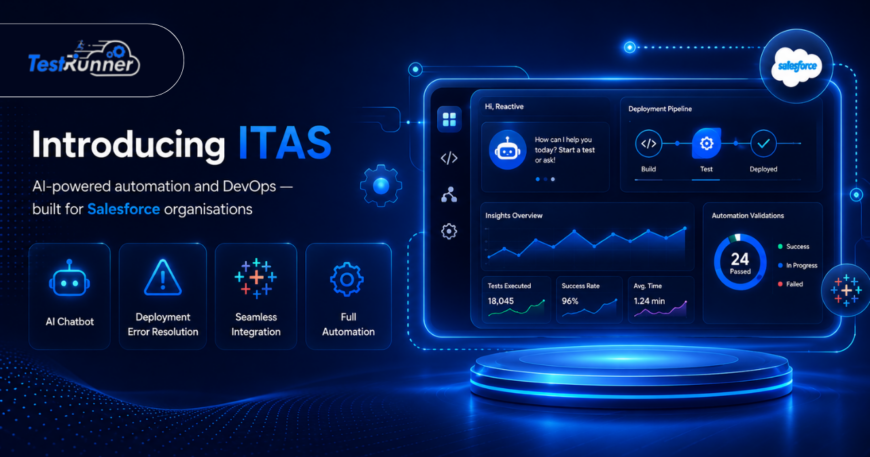
That is exactly the problem ITAS, powered by TestRunner, was built to solve.
I want to share five capabilities we have embedded into ITAS that represent a meaningful step forward not just for our clients, but for how the industry approaches automation at scale.
1. An AI chatbot built directly into ITAS
One of the most consistent pieces of feedback we receive is that powerful tools become a liability when teams cannot use them confidently. Onboarding takes too long. Support queues grow. Productivity suffers while people wait for answers. We addressed this by building an AI chatbot natively into the ITAS platform. It provides instant, contextual answers, guides users through workflows, and surfaces the right information at the right moment, without anyone needing to leave the platform or raise a ticket.
| The result is faster adoption, reduced dependency on support, and teams that can move independently from day one. |
2. AI-powered deployment error resolution
A failed deployment used to mean hours of investigation, engineers sifting through logs, escalating issues, delaying releases. The cost was not just technical. It was organizational: delayed timelines, frustrated stakeholders, and engineering capacity diverted away from building.
ITAS now uses AI to automatically detect deployment errors, identify root causes, and surface actionable recommendations in real time.
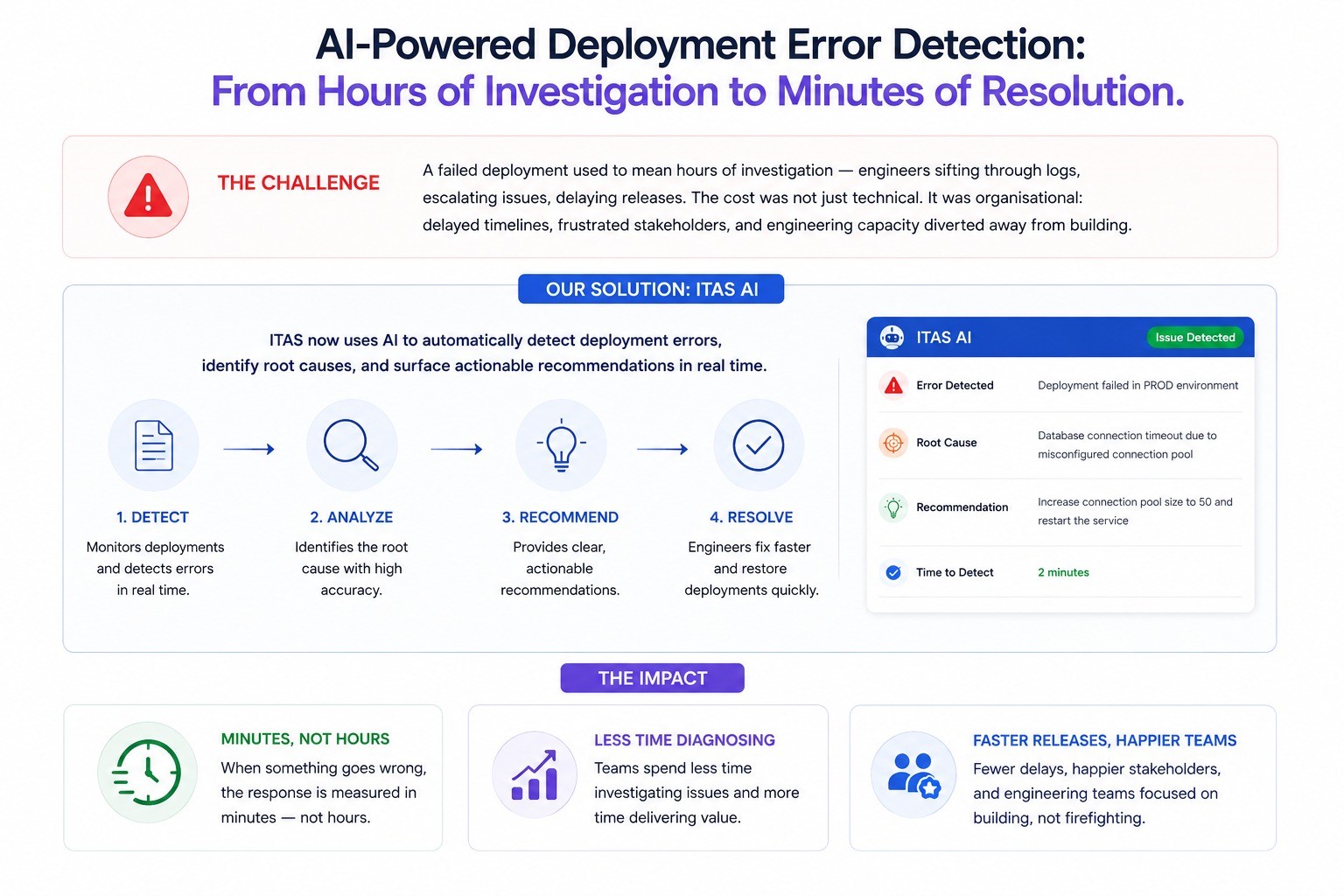
| When something goes wrong, the response is measured in minutes, not hours. Teams spend less time diagnosing and more time delivering. |
2.1. End-to-end automation with full visibility
At the foundation of everything ITAS does is TestRunner, our automation engine designed for enterprise-grade reliability. TestRunner orchestrates the full delivery pipeline: test execution, workflow management, and deployment, all in one place, with complete visibility across every stage. For leaders, this matters because it removes the guesswork. You know what is running, what has failed, and what needs attention, without having to chase it down across disconnected tools
3. Tableau Integration: Live Analytics inside ITAS
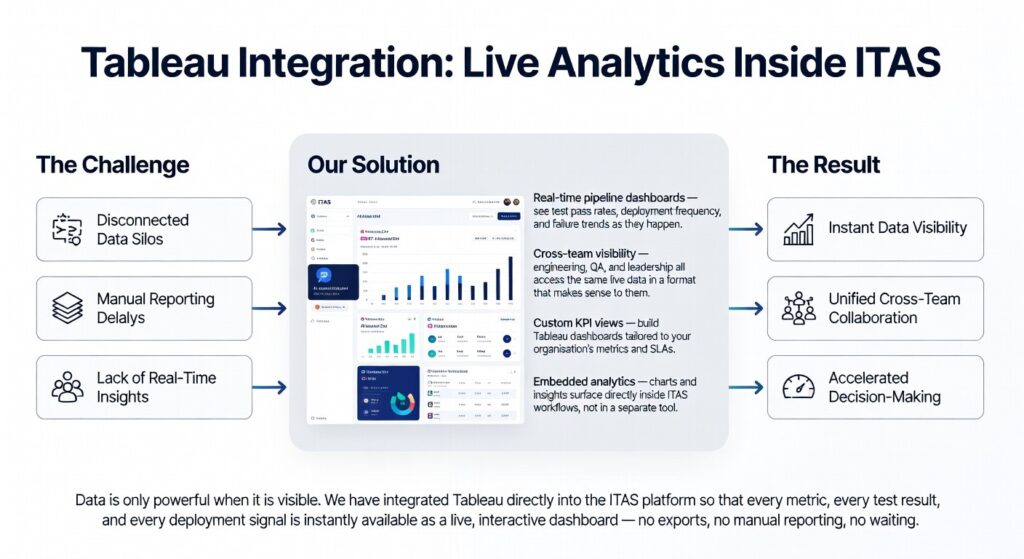
Data is only powerful when it is visible. We have integrated Tableau directly into the ITAS platform so that every metric, every test result, and every deployment signal is instantly available as a live, interactive dashboard, no exports, no manual reporting, no waiting.
3.1 What our Tableau integration delivers
- Real-time pipeline dashboards: see test pass rates, deployment frequency, and failure trends as they happen.
- Cross-team visibility: engineering, QA, and leadership all access the same live data in a format that makes sense to them.
- Custom KPI views: build Tableau dashboards tailored to your organisation’s metrics and SLAs.
Embedded analytics: charts and insights surface directly inside ITAS workflows, not in a separate tool.
| With Tableau embedded in ITAS, your team stops asking ‘what happened?’ and starts asking ‘what’s next?, because the answer is always right in front of them. |
4. Salesforce OmniStudio: CRM Automation at Its Best
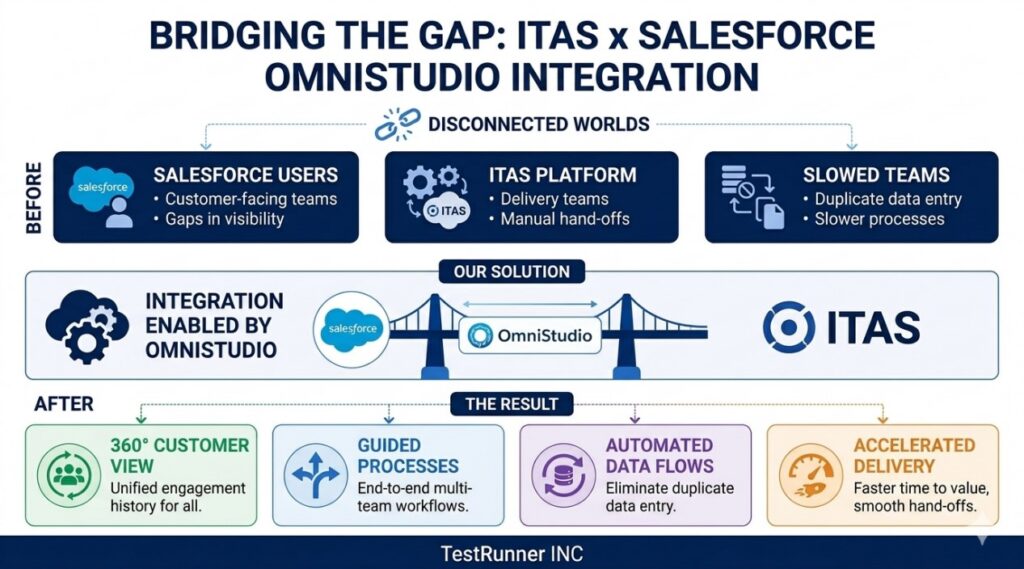
Customer-facing teams run on Salesforce. Delivery teams run on ITAS. Until now, those two worlds rarely talked to each other, leaving gaps in visibility, manual hand-offs, and duplicate data entry that slowed everyone down. With our Salesforce OmniStudio integration, ITAS bridges that gap. We connect your end-to-end delivery pipeline directly into the Salesforce ecosystem, enabling guided processes, automated data flows, and a 360-degree view of every customer engagement.
4.1 What we do with Salesforce OmniStudio
- FlexCards: surface live ITAS data (test status, deployment health) directly on Salesforce record pages.
- DataRaptors: automate data reads and writes between ITAS and Salesforce with zero manual intervention.
- OmniScripts: build guided, step-by-step workflows that combine ITAS automation with Salesforce CRM actions.
- Integration Procedures: orchestrate complex multi-system processes triggered by Salesforce events.
- Real-time CRM sync: keep customer records, project status, and delivery milestones perfectly aligned.
| When ITAS and Salesforce OmniStudio work together, your delivery pipeline and your customer data are no longer two separate worlds, they become one intelligent, automated system. |
4.2 What this means for your organization
By reducing manual work for engineering teams, the platform enables faster and more reliable releases with significantly fewer deployment failures. It provides full pipeline visibility across every workflow, allowing teams to monitor, track, and optimize deployments with complete transparency. Integrated live Tableau dashboards deliver real-time, data-driven insights for smarter decision-making, while built-in Salesforce OmniStudio CRM automation streamlines customer and operational processes. Together, it creates one unified platform that seamlessly connects software delivery with customer data and business operations.
4.3 Why this matters now
The software and IT services sector is under pressure to deliver more, faster, with leaner teams. The organizations that will lead are not those with the largest headcount; they are those with the most intelligent systems underneath them.
ITAS is our answer to that challenge. It is not automation for its own sake. It is automation that thinks, adapts, and helps your teams perform at a level that would not be possible manually.
Add Tableau’s analytics power and Salesforce OmniStudio’s CRM capabilities, and you have a platform that does not just run your pipeline; it illuminates it, connects it to your customers, and drives your business forward.

